Face Recognition for Web-Scale Datasets
E. G. Ortiz and B. C. Becker. “Face Recognition for Web-Scale Datasets”. ELSEVIER Computer Vision and Image Understanding, 2013.
Related Publication: B. C. Becker and E. G. Ortiz. “Evaluating Open-Universe Face Identification on the Web”. IEEE CVPR Workshop on Analysis and Modeling of Faces and Gestures, 2013. [Project Page]
B. C. Becker, E. G. Ortiz. “Evaluation of Face Recognition Techniques for Application to Facebook”. IEEE International Conference on Automatic Face and Gesture Recognition.
Motivation
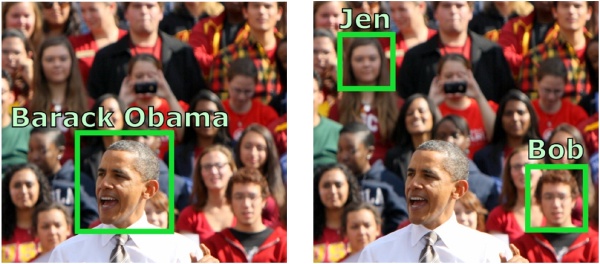
With the increasing pervasiveness of digital cameras, the Internet, and social networking, there is a growing need to catalog and analyze large collections of photos. Because photo interest is largely determined by who appears in the picture, labeling photos with identities is particularly important. In fact, popular social networks such as Facebook allow users to place tags on photos to label people, encouraging collaboratively organized photo albums amongst friends. Imagine millions of social network users needing to tag their photos: such web-scale labeling problems present a real challenge and fascinating opportunity for automation by face recognition.
Results
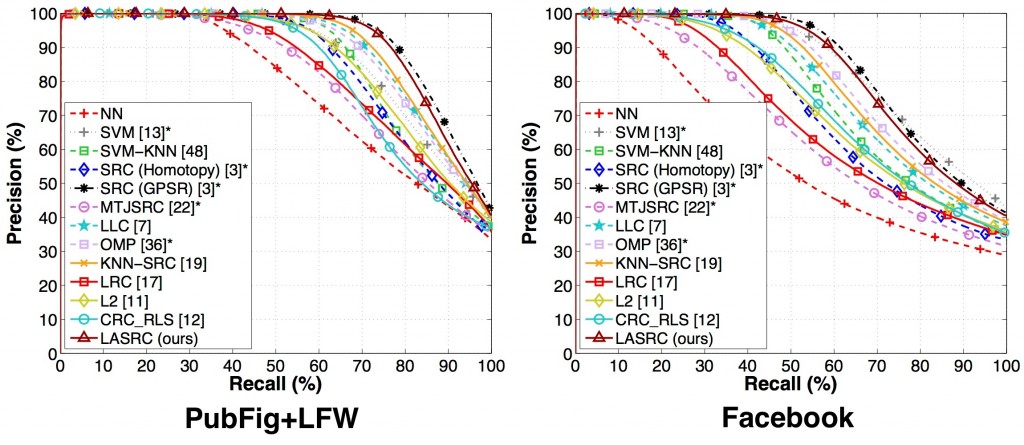
SRC based methods outperform all other methods in terms of precision and recall. It is important to notice that our method performs comparably to standard SRC, but with a 100x speedup as seen in the timing diagram below.
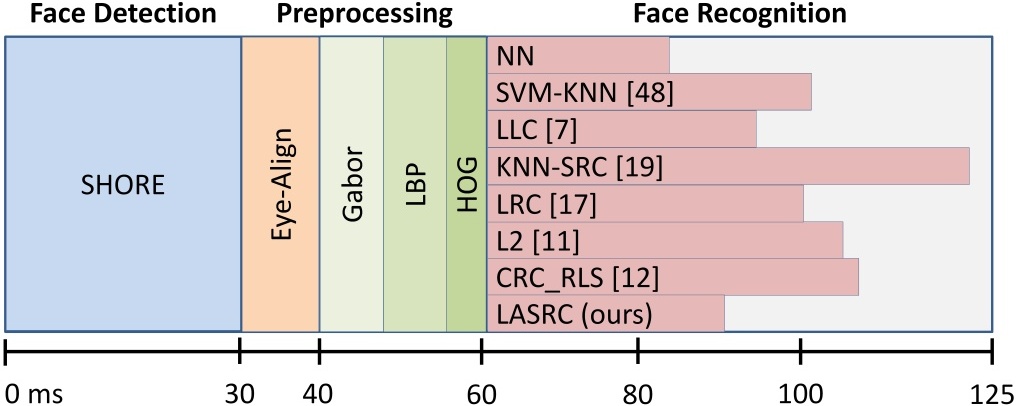
Timeline of all steps in the entire face recognition system. All times reported with a single core of a 2.27 GHz machine.
Availability
The datasets and toolbox from this work are no longer distributed. The download links printed in the paper and on third-party pages are retired.